
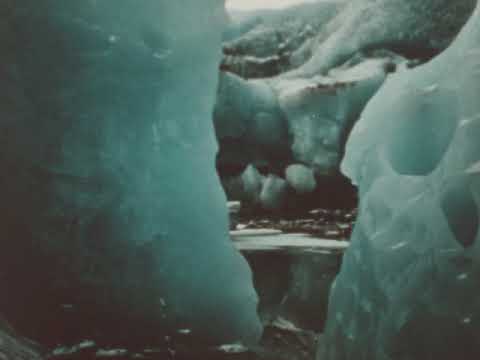
Understanding Our Earth: Glaciers (1977)
Email us at footage@avgeeks.com if you have questions about the footage and are interested in using it in your project.
Understanding Our Earth: Glaciers is a classroom educational film that introduces students to the science of glaciology through the voice of a narrator who describes Alaska — “a paradise of glaciers” — as a starting point for exploration. The film explains how glaciers form when snow accumulates over many years in high-altitude or high-latitude regions where summers are too short and cool for all the snow to melt, eventually compressing into slow-moving rivers of ice. It covers the different types of glaciers, particularly valley glaciers found in places like Alaska, the Canadian and American Rockies, and the Andes, as well as the massive continental ice sheets near the South Pole, where scientists work at research stations. The film walks through how glaciers move and erode the landscape, calving icebergs into the sea, depositing glacial till, and sculpting features still visible across North America today — from the lake basins of the Midwest and gravel hills of New England to broad U-shaped valleys. It closes by touching on the concept of ice ages, noting that some scientists believe the periodic triggering of new ice ages remains an open scientific question.

About The Author