
The Doppler Effect (1951)
Email us at footage@avgeeks.com if you have questions about the footage and are interested in using it in your project.
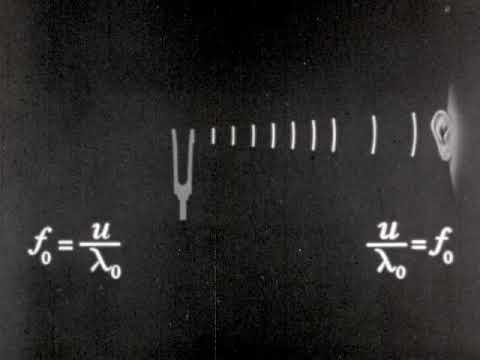
This fill explains the physical principles behind the Doppler effect, illustrating how the frequency of wave arrivals determines the perceived pitch of a sound. It breaks down the mathematical relationship between wave speed, wavelength, and frequency, demonstrating how these factors change when either the sound source or the observer is in motion. By analyzing scenarios where a source moves toward or away from a stationary listener—or conversely, where a listener moves relative to a stationary source—the film clarifies why the pitch of a sound appears to shift, providing real-world context through examples such as passing trains and road signals.
Keywords: Doppler effect, physics, wave frequency, wavelength, acoustics, sound, pitch, motion, wave speed, longitudinal waves


About The Author