I Am the Way: The Hours of Trial, Part 2 (1931)
Email us at footage@avgeeks.com if you have questions about the footage and are interested in using it in your project.
This is a 1931 silent film produced and distributed by the **Religious Motion Picture Foundation** of New York City, presented as “a pictorial study of Jesus’ life and ministry in Holy Land settings.” As the title suggests, this is Part 2 of a series, focusing specifically on the trial and passion narrative.
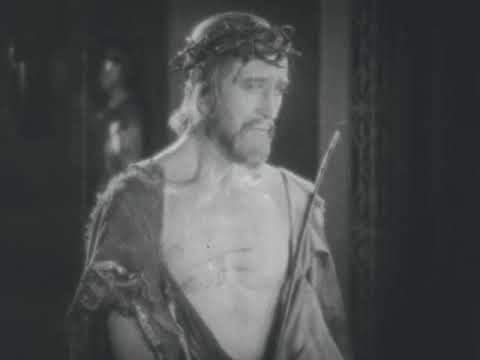
The film opens at **the Hall of Judgement**, where a large crowd has already assembled by early dawn. The central dramatic tension is Pilate’s moral dilemma: he recognizes Jesus as innocent but is afraid to act against the pressure of the mob. In an attempt to avoid condemning Jesus outright, **Pilate orders Jesus to be scourged**, hoping this will satisfy the crowd.
This fails. In a further desperate effort, **Pilate calls Jesus before the people again**, apparently hoping that the sight of a beaten man will inspire mercy. The crowd, however, is stirred up by the chief priests, and they **demand Barabbas** — a chained prisoner — be released instead.
Pilate appeals to the crowd a second time, asking what should be done with Jesus. The mob’s answer is unambiguous, and finally, **yielding to their clamor, Pilate orders Jesus to be crucified.**
The film then depicts the subsequent events visually: Jesus carrying the cross through the streets, mourning women, the procession to Golgotha, and ultimately the **crucifixion** itself, shown as three figures on crosses against a dark, stormy sky.
The film is a straightforward, reverent dramatization of the Gospel passion narrative, shot in what appear to be elaborate studio sets designed to evoke Holy Land architecture and atmosphere.
About The Author